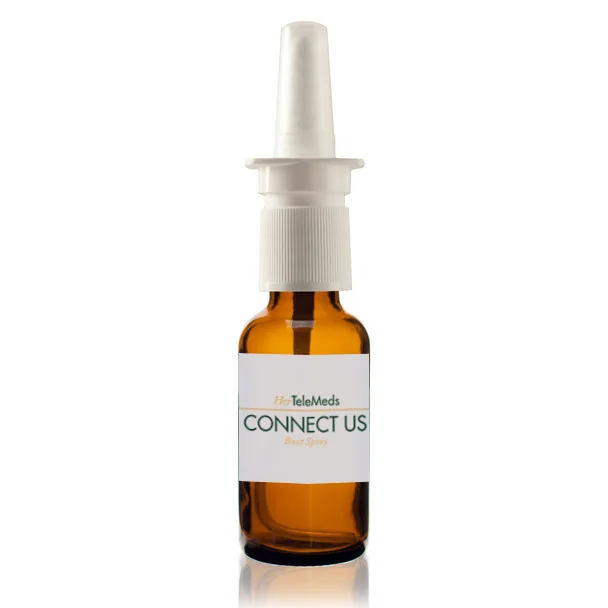
What is oxytocin and why would it help with desire?
+
Oxytocin is a neuropeptide the body produces naturally — released during physical touch, eye contact, and moments of bonding. It reduces activation of the amygdala (the brain's threat-detection center), increases felt safety and trust, and creates the neurological conditions in which intimacy feels possible. Low desire in women is often driven by too much activation of the sexual brakes — stress, disconnection, threat — rather than too little stimulation to desire itself. Oxytocin works on that threat-brake system directly, from the brain down.
I've tried libido supplements and nothing has worked. How is this different?
+
Most OTC libido products work through one of two mechanisms: attempting to increase hormonal drive (DHEA, maca, herbal adaptogens) or increasing genital blood flow and sensitivity (topical arousal products). Connect Us works on a third mechanism — the brain's neurological readiness for connection and intimacy. For women whose low desire is rooted in stress, disconnection, depletion, or a nervous system that doesn't feel safe enough to open, addressing the brain state directly is a different and complementary approach.
How does this compare to Scream Cream?
+
Scream Cream is a topical arousal product — applied directly to genital tissue, it increases local blood flow and sensitivity, supporting physical arousal and sensation. Connect Us addresses a different part of the experience: the desire and wanting that precedes physical arousal. One addresses arousal; the other addresses desire. They work on different parts of the sexual response process and can be used complementarily. Discuss with your HerTeleMeds clinician which, or which combination, is right for your experience.
What does the research actually show?
+
Published research on intranasal oxytocin for sexual function shows real and meaningful effects on the relational and experiential dimensions of intimacy. Women in the Behnia 2014 study reported feeling more relaxed and showed better ability to share sexual desires and empathize with their partners. Intranasal oxytocin supported increased intensity of orgasm and contentment after intercourse. It's worth noting that the Muin long-term RCT found that both oxytocin and placebo improved sexual function scores — suggesting that the ritual, intention, and attention that comes with use also has a meaningful effect. Connect Us is honest about this: it's a tool for supporting the conditions for intimacy, not a pharmaceutical treatment for a diagnosed disorder.
I don't feel desire anymore — is something wrong with me?
+
Sometimes desire doesn't come first. You may not start out feeling "in the mood," but once you begin connecting, touching, relaxing, or engaging with your partner, desire can naturally follow. This is called responsive desire, and it's a completely normal way many people experience sexuality, though it's not a concept many people are taught. Most of us are more familiar with spontaneous desire, which most often shows up in men or in the honeymoon phase of a relationship. Neither is better — they are both desire.
When women lack desire, the reason is more often too many brakes than too few accelerators. Stress, depletion, relational disconnection, perimenopause, and depression are all brake activators. Nothing about the absence of desire makes you broken. It makes you a person whose nervous system is responding to its environment. Connect Us is one tool in a multi-tiered approach that your HerTeleMeds clinician can help you build.
Can I use this if I'm in perimenopause or menopause?
+
Yes — and perimenopause and menopause are among the most common contexts in which desire shifts. The hormonal changes of this transition affect both the physical and neurological dimensions of sexual experience. For patients where a combined approach is relevant — oxytocin for the desire and connection dimension alongside estriol or other hormonal support for physical changes — your HerTeleMeds clinician can discuss whether a multi-product protocol makes sense for your situation.
How often should I use it?
+
Connect Us is a product designed to be used before intimacy rather than daily. There's no required frequency. Some patients use it occasionally when they want extra support; others incorporate it more regularly as part of their intimacy practice. Your HerTeleMeds clinician will advise on what's appropriate for your specific context.