
HerTeleMeds
← Back
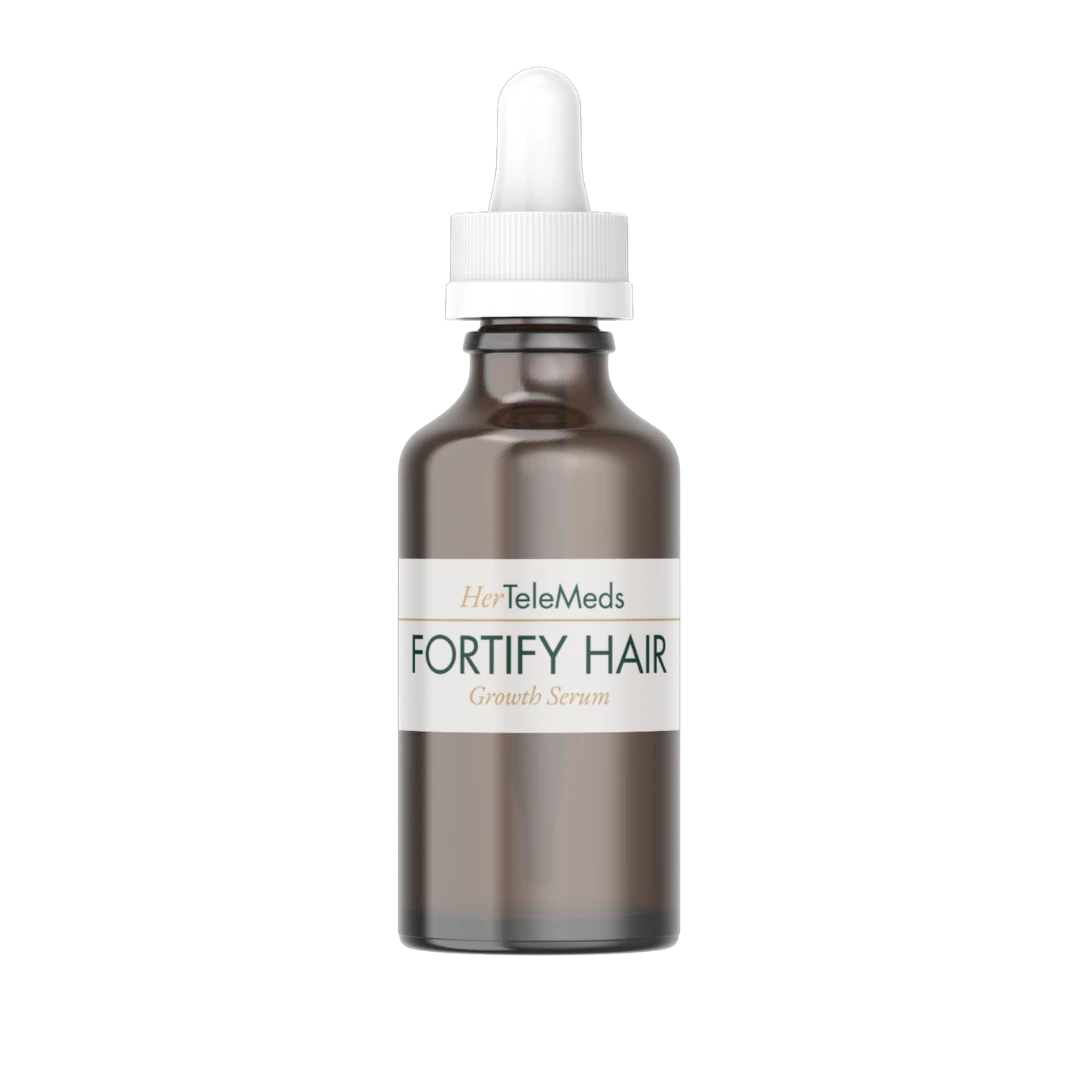
Fortify Hair Growth Serum jar
RxPrescription Included

Fortify Hair Growth Serum — Minoxidil 5% + Dutasteride 0.3% + Tretinoin 0.01%

When minoxidil alone isn’t enough, this is the next conversation.

Fortify Hair Growth Serum pairs minoxidil’s proven vasodilation with dutasteride — a dual-enzyme DHT blocker that works across both pathways finasteride leaves partially addressed — and tretinoin to maximize minoxidil absorption at the scalp level. For postmenopausal women who have plateaued on standard treatments and are ready for a clinician-prescribed, mechanism-targeted approach, this is precision hair restoration without the complexity of a multi-product stack.

Size

100ml (30-day supply)
Ships every 30 days
$99.00 per shipment
🔒 HIPAA Secure
🧪 Compounded in USA
📋 No Charge until approved

WHAT TO EXPECT

Results, stage by stage.

Three-year data shows dutasteride increased hair thickness in 83.3% of women with androgenetic alopecia — but that improvement is built over time, not delivered quickly.

WEEKS 4–8

Shedding slows

The first signal that treatment is working is often a reduction in active shedding rather than visible regrowth. The DHT-blocking mechanism of dutasteride begins interrupting follicle miniaturization from the first weeks of use. Tretinoin is simultaneously improving minoxidil’s bioavailability at the scalp.

MONTHS 3–4

First regrowth signs

A 2025 Phase II trial found dose-dependent gains in target-area hair count with topical dutasteride, with measurable improvements emerging at the 24-week mark. Finer, shorter hairs at the part line and crown indicate follicles are responding. Phase II preclinical trials showed a 30% increased improvement in hair count when comparing dutasteride to finasteride at 6 months.

MONTHS 6–9

Visible density improvement

Months 6 to 9 represent the window for visible density improvement at the crown and frontal areas in most responders. Hair diameter and shaft strength improve as the follicles that dutasteride has protected from DHT grow through full cycles.

YEAR 1 AND BEYOND

Sustained results

Month 12 and beyond represents peak gains. Stopping treatment reverses progress over the following 6 to 12 months. FPHL treatment is a long-term protocol. Your HerTeleMeds clinician will guide your ongoing plan.

Dutasteride is more potent than finasteride — but that potency is matched with a higher importance of consistent use and clinician oversight. Individual response varies based on duration of hair loss, hormonal profile, and degree of follicle miniaturization at the time treatment begins. Earlier treatment preserves more options.

Fortify Hair Growth Serum jar

ABOUT THE TREATMENT

What is Fortify Hair Growth Serum?

Why this formulation exists

For women who have tried topical minoxidil and found it insufficient — or who have reached a plateau after years of use — the question is whether the treatment is targeted enough. Fortify Hair Growth Serum was compounded to address that gap with three actives working on three separate mechanisms simultaneously.

Why dutasteride and not just finasteride

Finasteride inhibits only Type 2 5-alpha reductase — the isoenzyme found primarily in the inner root sheath of the hair follicle. Dutasteride inhibits both Type 1 and Type 2 5-alpha reductase, and is approximately 3 times as potent as finasteride at inhibiting Type 2 and more than 100 times as potent at inhibiting Type 1. Dutasteride lowers serum DHT by approximately 98% compared to 71% for finasteride.

Type 1 5-alpha reductase is found primarily in the skin, sebaceous glands, and liver — including the scalp tissue directly surrounding hair follicles. For women with FPHL that hasn’t responded adequately to finasteride or other treatments, addressing both enzyme isoforms represents a meaningfully different intervention. Someone searching for dutasteride has typically already encountered finasteride — and found it either insufficient or not the right fit.

How each active works

Minoxidil 5% is the only FDA-approved topical treatment for female pattern hair loss. It extends the anagen phase by improving blood flow and nutrient delivery to hair follicles. At 5%, it delivers a stronger vasodilatory signal than the 2% OTC formulation most patients have already tried.

Dutasteride 0.3% inhibits both Type 1 and Type 2 5-alpha reductase, reducing DHT at the scalp across both pathways. At 0.3%, it targets the DHT-driven miniaturization that is the primary mechanism of androgenetic hair loss in postmenopausal women.

Tretinoin 0.01% acts as a permeation enhancer and cellular activator. Topical tretinoin enhances the response to minoxidil in individuals with low follicular sulfotransferase activity — the enzyme required for converting minoxidil into its active form — with 43% of initial minoxidil non-responders becoming responders following tretinoin application. For women who have used topical minoxidil without sufficient results, the addition of tretinoin directly addresses one of the most common biological reasons for non-response.

Active ingredients
Minoxidil 5%, Dutasteride 0.3%, Tretinoin 0.01%
Dispense
100ml (30-day supply)

HOW TO USE

Four steps, every day

  1. STEP 01

    Apply to clean, dry scalp at night

    Apply 0.5–1 dropperful directly to the scalp — not to the hair — focusing on areas of thinning. Section hair to ensure the serum contacts the scalp directly. Nighttime application allows for full absorption and avoids UV interaction with tretinoin, which is photosensitive.

  2. STEP 02

    Massage gently into the scalp

    Use clean fingertips to massage the serum into the scalp for 1–2 minutes. This supports absorption and activates the vasodilatory mechanism of minoxidil. Wash hands thoroughly immediately after every application.

  3. STEP 03

    Allow full absorption before sleep

    Allow the serum to dry before lying down. Most patients apply at least 30 minutes before bed to minimize transfer to the pillowcase. Do not wash hair for at least 4 hours after application.

  4. STEP 04

    Consistent nightly use

    Dutasteride’s DHT-suppressing effect builds with consistent daily exposure at the scalp level. Skipping applications interrupts the DHT suppression cycle. Same time each night is the most effective protocol.

Dutasteride pregnancy contraindication: Dutasteride is FDA Pregnancy Category X. The drug can cause abnormalities in the genitalia of male fetuses and is absorbed through skin — topical formulations carry the same warning as oral dutasteride. Keep this product away from pregnant women and women who may become pregnant. Wash hands immediately and thoroughly after every application.

Dutasteride is approximately 3x more potent than finasteride at inhibiting Type 2 5-alpha reductase, and more than 100x more potent at inhibiting Type 1 — blocking both enzyme pathways finasteride leaves partially addressed

Three-year data: dutasteride increased hair thickness in 83.3% of women with androgenetic alopecia

Tretinoin converts 43% of topical minoxidil non-responders into responders by enhancing follicular sulfotransferase activity

Three mechanisms in one formula: dual-enzyme DHT suppression, scalp vasodilation, and minoxidil bioavailability enhancement

How HerTeleMeds Works

How HerTeleMeds Works

  1. 01

    Tell us about you

    Answer a few questions about your skin and medical history.

  2. 02

    Get evaluated

    A U.S.-licensed provider reviews your information within 24 hours.

  3. 03

    Treatment ships

    If prescribed, your compounded formula is made fresh and arrives discreetly — often within 2–3 days.

  4. 04

    Apply daily

    One application a day. Results build gradually with consistent use.

Product details

The fine print

Active
Minoxidil 5%, Dutasteride 0.3%, Tretinoin 0.01%
Inactive
Propylene Glycol, Dehydrated Alcohol
Dispense
100ml (30-day supply)

FAQ

Questions, answered.

What is dutasteride and how does it differ from finasteride?

+

Both are 5-alpha reductase inhibitors — they block the enzyme that converts testosterone into DHT, the androgen responsible for follicle miniaturization in androgenetic hair loss. The key difference is scope: dutasteride inhibits both Type 1 and Type 2 5-alpha reductase, while finasteride targets only Type 2. Dutasteride is approximately 3 times as potent as finasteride at Type 2 and more than 100 times as potent at Type 1. For women whose hair loss has not responded adequately to finasteride, dutasteride addresses the enzyme pathway that finasteride leaves active.

Why does this formula include tretinoin?

+

Tretinoin serves a specific and clinically meaningful role. Topical tretinoin enhances the response to minoxidil by boosting follicular sulfotransferase activity — the enzyme required to convert minoxidil into its active form. This converted 43% of initial minoxidil non-responders into responders. For women who have used topical minoxidil and found it insufficient, tretinoin directly addresses one of the most common biological explanations for that non-response.

Who is this formulation most appropriate for?

+

Postmenopausal women with FPHL who have plateaued on or not responded adequately to standard topical minoxidil, or who have researched past finasteride and want a more targeted DHT-blocking approach. Three-year data shows dutasteride increased hair thickness in 83.3% of women with androgenetic alopecia. This is an appropriate formulation for women who are ready for a more intensive protocol and whose clinician has confirmed their candidacy.

How does this compare to the Full Hair Growth Serum (Gentle)?

+

Both formulas target FPHL through multiple mechanisms. The Gentle formulation uses finasteride at 0.1% alongside ketoconazole and azelaic acid — designed for patients who want multi-mechanism coverage with a lower-concentration finasteride. Fortify uses dutasteride at 0.3%, which provides broader and more potent DHT suppression across both enzyme pathways. Fortify is the step up for patients whose profile calls for more targeted DHT blockade — and whose clinician has assessed them as appropriate candidates.

Is this safe for postmenopausal women specifically?

+

Three-year data shows dutasteride and finasteride given daily effectively increased hair thickness and arrested further deterioration in women with androgenetic alopecia, including women over 50. The pregnancy contraindication for dutasteride is absolute for women who are or may become pregnant. For postmenopausal women who are definitively past reproductive age and not at risk for pregnancy, this contraindication does not apply in the same way — your HerTeleMeds clinician will confirm your specific candidacy at consultation.

How long before I see results?

+

Reduced shedding is typically the first signal, often within 4–8 weeks. Initial regrowth at thinning areas typically becomes visible by months 3–4. Months 6–9 represent the window for visible density improvement at crown and frontal areas in most responders, with peak gains at month 12 and beyond. Consistency is the variable most within your control.

Does topical dutasteride carry the same side effects as oral?

+

Some systemic absorption does occur with topical dutasteride — sexual side effects, breast tenderness, and mood changes can occur. Reported rates in published data are notably lower than with oral dutasteride. Every HerTeleMeds prescription is preceded by a thorough clinical consultation to discuss these risks and confirm candidacy.

The treatment you’ve been researching. Prescribed for where you are.

Fortify Hair Growth Serum is for women who understand their hair loss and are ready for a prescription that matches that understanding. A HerTeleMeds clinician will review your full history, confirm this formulation is right for your profile, and get you started on a protocol built around the mechanisms that actually drive postmenopausal FPHL.

Start your consultation

Ships in 2–3 days. Prescription included with your visit. Cancel anytime.