HerTeleMeds
← Back
Regenerative Repair Cream (2%) jar
RxPrescription Included

Regenerative Repair Cream — GHK-Cu Copper Peptide 2%

The concentration where the clinical evidence peaks.

Regenerative Repair Cream at 2% delivers GHK-Cu at the concentration clinical research identifies as optimal for collagen synthesis — the point at which the peptide fully saturates the fibroblast receptors responsible for tissue remodeling, elastin production, and dermal repair. For patients ready to move from maintenance into meaningful structural change, this is the formulation built for that work.

Size

30g (30-day supply)
Ships every 30 days
$199.00 per shipment
🔒 HIPAA Secure
🧪 Compounded in USA
📋 No Charge until approved

WHAT TO EXPECT

Results, stage by stage.

Clinical studies demonstrating measurable collagen synthesis used 1–2% GHK-Cu — the concentration range at which optimal collagen synthesis occurs. At 2%, the full receptor-mediated signaling cascade is engaged, and results reflect that.

WEEKS 1–2

Surface response

Users may notice better skin hydration, reduced redness or irritation, and smoother skin texture within the first two weeks. The anti-inflammatory mechanism activates early — skin feels calmer, more supple, and better hydrated before the structural collagen changes become visible.

WEEKS 4–8

Texture, tone, and early structural change

Initial improvements in skin texture, fine lines, wrinkles, and overall appearance are typically noticeable at 4–8 weeks. Realistic skin improvements begin appearing around week 4–6 as the first collagen remodeling cycle completes. At 2% — the dose at which fibroblast receptors reach full saturation — this phase tends to produce more measurable structural change than at maintenance concentrations.

WEEKS 8–12

Collagen remodeling

Structural improvements including firmness, fine line reduction, and collagen density changes become visible between weeks 6 and 12. In controlled studies, participants experienced up to 35% improvement in facial wrinkles and a 70% increase in skin elasticity over 12 weeks of consistent GHK-Cu use. These outcomes were documented at the 1–2% concentration range.

MONTHS 3–6

Sustained regeneration

After 3–6 months, as skin elasticity and firmness continue to improve, scars and hyperpigmentation may begin to noticeably fade. Long-term use leads to sustained collagen production, maintained skin hydration, and better overall skin health.

At 2%, some patients notice a brief surface adjustment in the first 1–2 weeks as cell renewal accelerates — mild redness or minor texture changes that resolve quickly. This is the skin responding to a full therapeutic signal. If adjustment symptoms are persistent, contact your HerTeleMeds clinician.

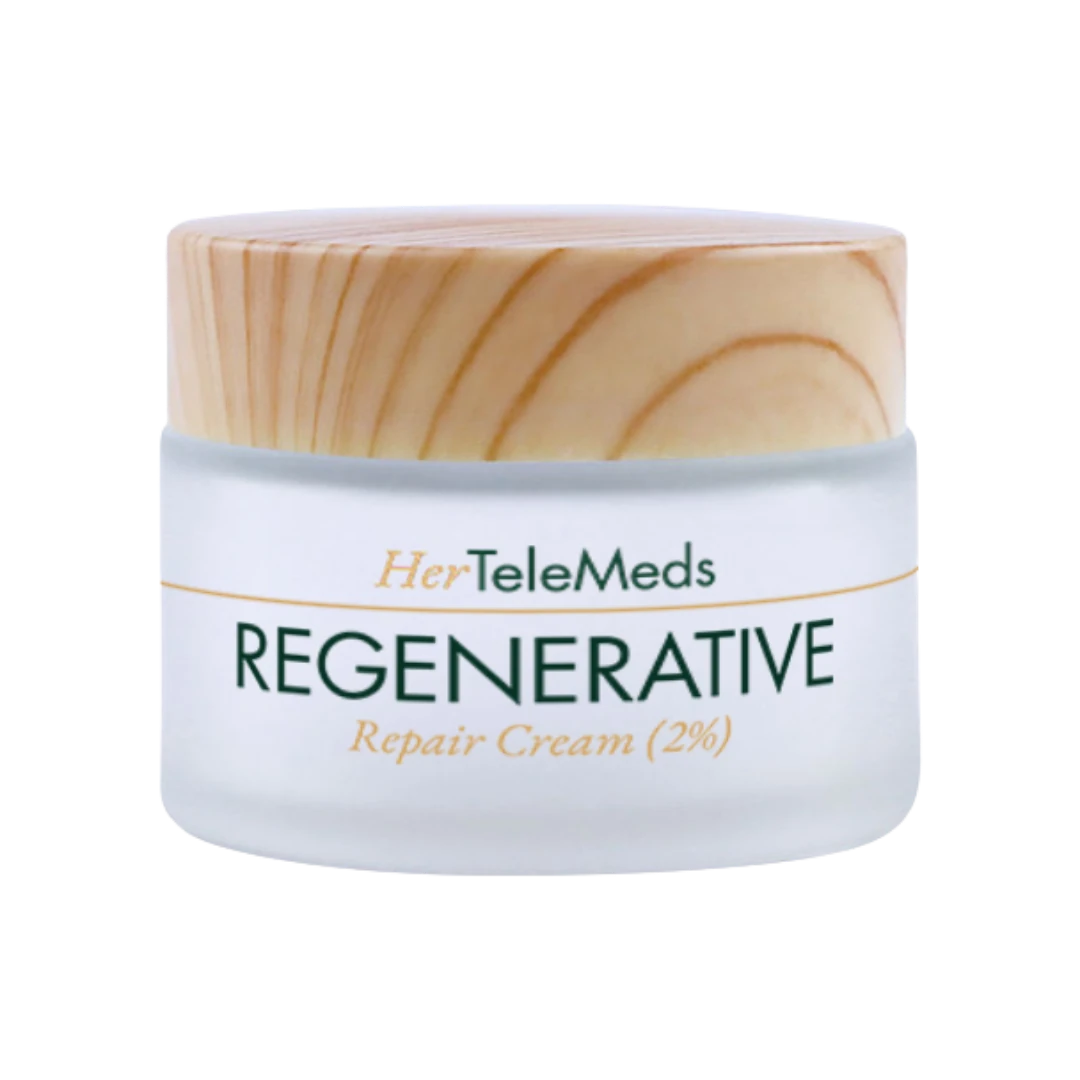
Regenerative Repair Cream (2%) jar

ABOUT THE TREATMENT

What is Regenerative Repair Cream (2%)?

Why concentration matters — and where it peaks

GHK-Cu functions through receptor-mediated signaling. Once GHK-Cu molecules occupy available TGF-beta receptors and integrin binding sites on fibroblast cell membranes, additional peptide has nowhere to bind — it oxidizes on the skin surface or rinses off. The clinical evidence is clear: studies demonstrating measurable collagen synthesis used 1–2% GHK-Cu, and concentrations above 3% do not increase efficacy because binding sites reach saturation.

This means 2% is the concentration at which GHK-Cu reaches the full extent of what topical application can achieve. The 0.5% formulation is well-suited for patients starting out or managing maintenance. The 2% formulation is where the clinical ceiling sits.

The biology

GHK-Cu is a naturally occurring copper-binding tripeptide that modulates tissue repair, collagen production, and cellular signaling in the skin — but levels drop significantly with age. By your 60s, you have roughly 60% less circulating GHK-Cu than you did at age 20. At 2%, Regenerative Repair Cream restores that deficit to the level at which the skin’s fibroblast signaling system operates at full capacity.

What GHK-Cu at 2% does

Drives collagen and elastin synthesis at peak clinical intensity — in a human trial comparing topical GHK-Cu to vitamin C and retinoic acid, GHK-Cu resulted in collagen increases in 70% of volunteers, outperforming both comparators. The studies producing these results used concentrations in the 1–2% range.

• Supports dense, resilient extracellular matrix — the structural scaffolding that determines skin firmness and visible plumpness • Reduces inflammation and oxidative stress — GHK-Cu demonstrates anti-inflammatory and antioxidant activity, which is why patients with redness-prone skin often see improvement alongside anti-aging benefits • Accelerates repair of cumulative damage — surgical scars, sun damage, and the micro-inflammation that accumulates over decades all respond to a fully engaged regenerative signal

Who this is for

The 2% formulation is best suited for patients in perimenopause or menopause managing active signs of aging — fine lines, skin laxity, loss of density, or persistent surface irregularities — who want the formulation the clinical evidence supports most strongly. Clinical studies show GHK-Cu often outperforms retinoids in tolerability — making the 2% formulation a strong option even for patients whose skin doesn’t tolerate tretinoin.

Active ingredients
GHK-Cu Peptide 2%
Dispense
30g (30-day supply)

HOW TO USE

Four steps, every day

  1. STEP 01

    Apply to clean, dry skin

    Apply a thin layer to completely clean, dry skin. At 2%, a thin, even layer is sufficient — receptor saturation occurs at this concentration, so more product does not produce more benefit.

  2. STEP 02

    Use once or twice daily

    Once daily is the appropriate starting point, particularly if stepping up from the 0.5% formulation. Apply to the face, neck, and any other areas you’re targeting for collagen enhancement and anti-aging effects. Build to twice daily as your skin settles in.

  3. STEP 03

    Sequence carefully with other actives

    Avoid combining GHK-Cu in the same application session with strong vitamin C, retinol, or alpha hydroxy acids — these can interact with copper peptides and reduce their effectiveness or cause irritation. If you are using Luminant All-In-One Face Cream, apply Regenerative Repair Cream in the morning and Luminant at night.

  4. STEP 04

    Follow with SPF in the morning

    Daily SPF 30 or higher protects the collagen being actively produced. Sun damage is the primary driver of collagen breakdown — without it, the structural work this cream is doing is undermined.

If stepping up from 0.5%: give your skin 1–2 weeks at the 2% concentration before assessing tolerance. Some patients notice more surface renewal activity in the first week — this is expected and resolves.

Clinical studies demonstrating measurable collagen synthesis used 1–2% GHK-Cu — the concentration at which fibroblast receptor saturation occurs and optimal collagen synthesis is achieved

Up to 35% improvement in facial wrinkles and 70% increase in skin elasticity documented over 12 weeks in controlled studies — at concentrations in the 1–2% range

GHK-Cu often outperforms retinoids in tolerability — a strong option for patients whose skin doesn’t tolerate tretinoin

Clinician-assessed and prescribed — your concentration is matched to your goals and skin history

How HerTeleMeds Works

How HerTeleMeds Works

  1. 01

    Tell us about you

    Answer a few questions about your skin and medical history.

  2. 02

    Get evaluated

    A U.S.-licensed provider reviews your information within 24 hours.

  3. 03

    Treatment ships

    If prescribed, your compounded formula is made fresh and arrives discreetly — often within 2–3 days.

  4. 04

    Apply daily

    One application a day. Results build gradually with consistent use.

Product details

The fine print

Active
GHK-Cu Peptide 2%
Inactive
Compounded base — full inactive ingredient list available on request.
Dispense
30g (30-day supply)

FAQ

Questions, answered.

Why is 2% the concentration the clinical evidence points to?

+

GHK-Cu functions through receptor-mediated signaling. Once GHK-Cu molecules occupy available TGF-beta receptors and integrin binding sites on fibroblast cell membranes, additional peptide has nowhere to bind. Clinical studies demonstrating measurable collagen synthesis used 1–2% GHK-Cu — and concentrations above 3% do not increase efficacy because binding sites reach saturation. At 2%, the full signaling cascade is engaged. That’s the distinction: not more, but complete.

What’s the difference between the 0.5% and 2% formulations?

+

Both formulations work through the same mechanism — restoring GHK-Cu levels that have declined with age and activating the skin’s collagen and repair signaling pathways. The 0.5% formulation is effective for maintenance and early prevention. The 2% is where clinical studies demonstrate optimal collagen synthesis — the range at which maximum collagen synthesis is documented. The choice reflects clinical goals, not simply a preference for a higher number.

Does higher concentration always mean better results with GHK-Cu?

+

With GHK-Cu, the answer is no — and that’s a meaningful distinction. Concentrations above 3% do not increase efficacy because copper peptide binding sites on fibroblast membranes reach saturation. Additional peptide has nowhere to bind and oxidizes on the skin surface. 2% is where the clinical ceiling sits for topical application. Going higher doesn’t produce more collagen — it produces more cost and more potential for surface irritation.

How does this compare to OTC copper peptide serums at higher concentrations?

+

OTC products frequently market 5% or 10% copper peptide concentrations — but the biology doesn’t support those numbers producing better outcomes. Standard cream bases deliver less than 5% of applied GHK-Cu to viable epidermis regardless of the label concentration. Formulation architecture matters more than peptide concentration on the label. Regenerative Repair Cream 2% is compounded at a verified therapeutic concentration by a pharmacy with over 35 years of specialized experience, using a formulation designed for actual dermal delivery. Your prescription is reviewed by a clinician before every fill.

Can I use this if my skin doesn’t tolerate tretinoin?

+

Clinical studies show GHK-Cu enhances dermal thickness and elasticity, often outperforming retinoids in tolerability. GHK-Cu does not cause the retinization period, photosensitivity, or purging that tretinoin can produce. For patients whose skin is too reactive for tretinoin-based formulations, Regenerative Repair Cream 2% is a clinically meaningful alternative that delivers structural skin improvement through a different and generally better-tolerated mechanism.

Can I use this alongside other HerTeleMeds skincare prescriptions?

+

Generally yes — but sequencing matters. Avoid combining GHK-Cu in the same application session with vitamin C, retinol, or alpha hydroxy acids. If you are using Luminant All-In-One Face Cream, apply GHK-Cu in the morning and the tretinoin-containing product at night. Your HerTeleMeds clinician will advise on the right routine for your specific combination.

How long before I see results?

+

First results in skin hydration and texture typically appear within the first 1–2 weeks. Fine lines and wrinkles begin to fade after 1–2 months as texture and elasticity improve. After 3–6 months, elasticity and firmness continue improving. At 2% — the concentration at which maximum collagen synthesis is documented — these results are as strong as topical GHK-Cu can produce.

Is this safe for long-term use?

+

To date, no existing research has discovered any serious safety concerns with the use of topical GHK-Cu copper peptides. Many patients use this as an ongoing daily protocol. Your HerTeleMeds clinician will review your response at each refill.

The concentration the research points to. Prescribed for you.

Regenerative Repair Cream at 2% delivers GHK-Cu at the dose clinical studies identify as optimal for collagen synthesis — fully engaging the skin’s fibroblast signaling pathways and producing the structural improvements that a maintenance concentration builds toward. Start your consultation today and let a HerTeleMeds clinician confirm whether this is the right step for where your skin is.

Start your copper peptide regimen

Ships in 2–3 days. Prescription included with your visit. Cancel anytime.